The Complete droven.io AI Career Roadmap for 2026
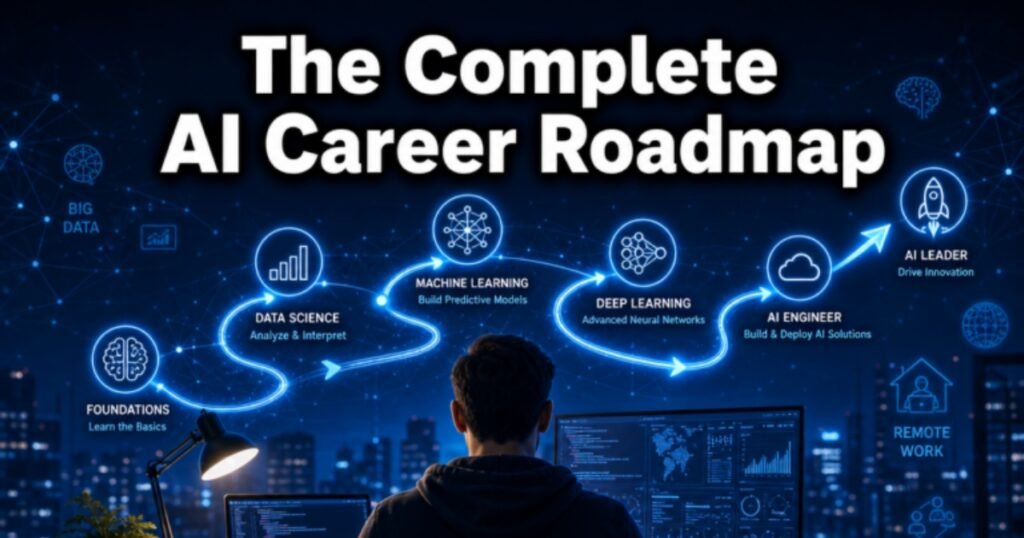
Artificial intelligence is no longer an isolated subfield of computer science reserved for academic researchers and specialized lab scientists. Today, machine learning models, generative AI architectures, and autonomous agent frameworks drive core operations across engineering, finance, healthcare, and enterprise software. With this massive shift comes unprecedented demand for skilled professionals who can design, deploy, and maintain intelligent systems. However, navigating this fast-evolving ecosystem can feel overwhelming without clear guidance. Following a structured framework like the droven.io ai career roadmap provides a clear, step-by-step path from fundamental concepts to enterprise-level architecture.
Whether you are a software engineer transitioning into machine learning, a data analyst expanding your technical toolkit, or a complete newcomer eager to break into tech, having a clear sequence of milestones makes all the difference. A well-designed roadmap transforms a chaotic mountain of tutorials into a focused, deliberate professional plan.
What Makes an AI Career Strategy Essential Today?
The tech industry moves at a breakneck pace. New frameworks, open-source models, and developer tools appear almost daily. For ambitious professionals, this rapid evolution creates both massive opportunity and significant confusion. Trying to learn everything simultaneously leads to burn-out, shallow understanding, and wasted effort.
This is where a methodical approach becomes invaluable. By relying on the droven.io ai career roadmap, learners can filter out short-term hype and concentrate on core principles that remain valuable over time. A great strategy helps you identify which skills yield the highest return on investment, how concepts build upon one another, and when to pivot toward specialized domains.
Instead of jumping blindly from one trending topic to another, a structured blueprint grounds your learning in sound engineering practices, mathematical foundations, and real-world execution.
Core Foundations: Essential Skills Covered in the Framework
Breaking into artificial intelligence requires a balanced foundation. You need sufficient mathematical literacy to understand how algorithms function under the hood, combined with strong software engineering habits to build reliable software.
Technical Mastery: Mathematics, Coding, and Data Handling
At the core of artificial intelligence lie three foundational pillars:
- Linear Algebra and Calculus: Understanding vectors, matrices, dot products, derivatives, and gradient descent is crucial for comprehending how neural networks optimize parameters.
- Probability and Statistics: Concepts like Bayes’ theorem, standard distributions, hypothesis testing, and statistical significance form the bedrock of data analysis and predictive modeling.
- Programming Proficiency: Python remains the undisputed standard language for machine learning, data science, and AI development. Clean syntax, object-oriented design, and efficient code execution are essential habits.
- Data Manipulation Libraries: Mastery over core Python libraries—including NumPy, Pandas, and Matplotlib/Seaborn—allows you to clean, transform, and visualize complex datasets effectively.
The droven.io ai career roadmap emphasizes establishing these core skills before moving on to advanced deep learning architectures or complex model tuning.
AI Tooling, Frameworks, and Workflow Automation
Once the basics are solid, the next requirement is familiarization with industry-standard development frameworks. Modern AI development relies on robust open-source tools:
- Machine Learning Frameworks: Scikit-learn for classical supervised and unsupervised algorithms; PyTorch or TensorFlow for building and training neural networks.
- Developer Tools: Jupyter Notebooks, Git version control, Docker containers, and virtual environments for reproducible workflows.
- Data Engineering Basics: SQL, data pipelines, and relational database management to feed high-quality data into machine learning models.
Stage-by-Stage Progression in the droven.io AI Career Roadmap
A successful career journey is best approached as a series of distinct, progressive phases. Jumping directly into advanced large language models without understanding baseline algorithms often leads to fragile knowledge.
Phase 1: Foundational Competency and Data Science Literacy
The initial stage focuses on building core problem-solving capability with data. Here, you learn to frame real-world problems mathematically, clean messy datasets, perform exploratory data analysis (EDA), and implement classical machine learning models like linear regression, decision trees, and random forests.
Understanding model evaluation metrics—such as precision, recall, F1 score, ROC-AUC, and mean squared error—is vital during this stage. By following the structured guidelines in the droven.io ai career roadmap, beginners build confidence through practical wins before tackling complex neural architectures.
Phase 2: Model Building, Fine-Tuning, and RAG Architecture
With classical algorithms mastered, the focus shifts toward deep learning and modern generative AI techniques:
- Neural Network Architectures: Convolutional Neural Networks (CNNs) for computer vision and Recurrent Neural Networks (RNNs/LSTMs) or Transformers for sequential and text data.
- Pre-trained Models and Transfer Learning: Leveraging existing foundational models (Hugging Face, OpenAI APIs) to perform custom tasks through fine-tuning.
- Retrieval-Augmented Generation (RAG): Combining vector databases (Pinecone, ChromaDB, Qdrant) with large language models to ground AI outputs in proprietary or domain-specific knowledge.
Phase 3: MLOps, System Architecture, and Production Deployment
Building a model in a notebook is only half the battle; deploying and maintaining it in production is where enterprise value is generated. This stage emphasizes Machine Learning Operations (MLOps):
- API Development: Packaging models into production-ready APIs using FastAPI or Flask.
- Model Monitoring and Governance: Tracking model drift, latency, API costs, and performance degradation over time.
- CI/CD Pipelines: Automated testing, containerization with Docker, and deployment across cloud environments like AWS, GCP, or Azure.
Sticking to the droven.io ai career roadmap during this phase ensures that learners develop end-to-end engineering skills rather than remaining confined to theoretical modeling.
Phase 4: Specialization and Strategic AI Leadership
The final stage of the roadmap involves choosing a dedicated niche and mastering domain-specific challenges. Whether focusing on computer vision, natural language processing, autonomous agents, or high-throughput AI infrastructure, professionals at this level combine deep technical expertise with strategic vision.
Choosing Your Pathway: Engineering, Research, or AI Operations
Artificial intelligence is not a single job role; it encompasses several distinct career tracks. Understanding which path aligns best with your background and goals is essential.
| Career Role | Core Focus | Primary Skills | Ideal Background |
| AI/ML Engineer | Building, integrating, and scaling AI models into software systems. | Python, PyTorch, Docker, APIs, Cloud Infrastructure | Software Developers, Computer Science Graduates |
| Data Scientist | Extracting insights, statistical analysis, and predictive modeling. | Statistics, SQL, Pandas, Scikit-Learn, Business Intelligence | Mathematicians, Statisticians, Business Analysts |
| MLOps Engineer | Automating pipelines, model deployment, and infrastructure monitoring. | CI/CD, Kubernetes, Terraform, AWS/GCP, System Design | DevOps Engineers, Infrastructure Specialists |
| AI Solutions Architect | Designing end-to-end AI systems aligned with organizational strategy. | System Architecture, Cloud Services, Security, Business Strategy | Senior Tech Leads, Solutions Engineers |
By consulting the droven.io ai career roadmap, professionals can easily evaluate these roles and tailor their daily learning schedule toward their desired specialization.
Hands-On Projects and Portfolio Building
Employers value demonstrable skills far more than certificates or credentials. A well-curated portfolio of real-world projects is the single best proof of your capability.
Moving Beyond Generic Tutorials
Many beginners fall into the trap of building duplicate projects like the Titanic survival predictor or basic MNIST digit classifiers. While useful for practice, these project templates rarely impress recruiters or hiring managers.
Instead, focus on projects that solve real, messy problems:
- Industry-Specific RAG Application: Build an intelligent assistant that ingests complex legal documents or medical papers and answers queries accurately with source citations.
- Automated Data Quality Pipeline: Create a tool that monitors incoming data streams, detects anomalies, and alerts engineering teams before corrupted data reaches downstream models.
- Multi-Agent Workflow System: Develop an autonomous multi-agent network (using frameworks like CrewAI or AutoGen) that collaborates to research topics, write drafts, and execute code autonomously.
Practical execution is a central pillar of the droven.io ai career roadmap, encouraging learners to document their build process publicly on GitHub and write technical breakdowns of their architecture.
Navigating the Job Market with Confidence
Securing a high-impact role requires strategic positioning. As competition grows, standing out requires a combination of technical competence, clear communication, and focused preparation.
Portfolio Optimization and Personal Branding
Your GitHub repositories, personal website, and technical write-ups serve as your primary digital storefront. Ensure your code repositories feature clean documentation, clear installation instructions, and concise summaries of the architectural choices you made.
Interview Preparation Strategy
AI technical interviews generally consist of three distinct components:
- Coding and Algorithms: Data structures, algorithms, and efficient Python implementation.
- Machine Learning Theory: Explaining model mechanics, trade-offs (bias vs. variance), evaluation metrics, and optimization techniques.
- System Design for AI: Designing scalable, cost-effective infrastructure capable of handling real-time model inference and high concurrent user traffic.
Utilizing the structured preparation guidance in the droven.io ai career roadmap helps job seekers approach each stage of the recruitment process with structure and confidence.
Continuous Learning and Staying Ahead in a Rapidly Evolving Field
In the modern technology ecosystem, learning does not stop once you land a job. Staying competitive requires cultivating habits that keep your knowledge sharp without causing cognitive overload.
Creating a Sustainable Upskilling Habit
Rather than trying to read every new research paper published on arXiv, establish a sustainable routine:
- Set aside 3 to 5 hours each week dedicated to experimental coding and testing new tools.
- Follow reputable tech publications, open-source maintainers, and engineering blogs from leading research labs.
- Join collaborative developer communities, open-source projects, and local tech meetups to share insights and troubleshoot real-world challenges alongside peers.
Integrating the droven.io ai career roadmap into your long-term professional development strategy ensures that your career growth remains steady, intentional, and adaptable over time.
Common Pitfalls in AI Career Planning and How to Avoid Them
Many aspiring AI professionals encounter avoidable roadblocks along their journey. Awareness of these common mistakes can save months of frustration.
1. Tutorial Hell and Lack of Practical Building
Consuming courses endlessly without writing original code creates a false sense of competence. The moment you face a blank code editor, progress grinds to a halt. Balance theory with immediate application.
2. Ignoring Basic Software Engineering Principles
An AI model is ultimately part of a larger software product. Writing fragile, unorganized code without testing or documentation limits your ability to contribute to production software systems.
3. Hyper-Focusing on Trending Frameworks
Tools and frameworks change rapidly, but foundational concepts remain constant. Master linear algebra, data structures, and baseline machine learning principles first; adapting to new tools will then take days rather than months.
Following the structured milestones of the droven.io ai career roadmap provides the guardrails needed to avoid these common traps and maintain steady momentum.
The Future Outlook for AI Professionals
The trajectory of artificial intelligence points toward deeper integration into everyday technology stacks. As generative tools and autonomous agent frameworks mature, the role of tech professionals is evolving from manual model development toward system orchestration, governance, and custom integration.
Engineers who combine strong foundational knowledge with adaptability will find incredible opportunities across every sector. By continuously upgrading your skills using the droven.io ai career roadmap, you position yourself at the forefront of this digital transformation, ready to build solutions that drive meaningful real-world impact.
Taking Your Next Step Today
Building a successful career in artificial intelligence is a marathon, not a sprint. Success comes down to consistency, deliberate practice, and following a logical progression. Start by auditing your current skill set, identifying your target role, and laying out your learning milestones. With the droven.io ai career roadmap guiding your efforts, you can move forward with clarity, purpose, and total confidence in your professional future.